
Unit 6- Media campaigns
Task 1- Film campaigns
A film campaign refers to the marketing and promotion of a new film set to be released. There are numerous different materials produced to build suspense, tension and anticipation leading up to the release of a new film.
Conventions of film trailers
- Film company logos are usually within the first part of the trailer. The production company's reputation can benefit a film trailer, for example, if people have seen and enjoyed another Universal or 20th Century Fox film, they may see the logo on a new trailer and decide to watch it because they enjoyed the last film the company created.
-The film title is in every trailer, so you know which film it is you want to watch and it is generally at the end of the trailer, so that you see if after you are already interested in the film and you are more likely to remember it. The font, colouring, and backdrop are all used to influence the genre of a film.
- Recently Social Media has become a popular convention of film trailers, for example; website URLs, twitter ‘hashtags’ or a Facebook page are used to encourage the audience to find out more about the film. Also if many people are talking about the film on social networking sites word-of-mouth can become an effective advertising campaign.
- Character Introductions are an important feature of film trailers. This is used because an audience get pleasure from films by connecting and relating to the characters, by their individual similarities; this is Star Theory.
-Music is a key feature, and can make or break the film trailers. They show the pace of film and genre, Voice overs are also important to guide the audience through the film plot and characters. A voice over can either be an external voice which is added on top of the footage, or the voice over can be sections of dialogue from the actual film
- In every trailer there will be name captions, these can be actor’s names, director’s names or producer’s names. These are generally at the end in a billing block although can be shown throughout the trailer in a transition of over an image. This is important because an audience can see a director or producer which they are either fans of, or weren’t.
- Usually a film will have more than one trailer made, with different sections of the film edited together for different audiences or time the trailer is being shown (watershed etc.). There is always an official full trailer which lasts sometime between 1.30 -2 minutes, but often you will find, especially in horror, action or thriller films, they have shorter 10 second trailers which help build hype. Theatrical trailers last between 2-2.5 minutes, and teaser trailers last between 30 seconds- 1 minute.
- Release dates are essential for attracting a large audience to the opening night of a film release. The release date is shown on trailers so it allows time for audiences to have seen it, but enough time so people can plan to see it soon, rather than forgetting about it by the time the date comes around. The release date is usually shown at the end of the trailer, like the film title, so that the trailer grabs the audience’s attention then gives them the information they need to go see it. Common phrases used may be “Coming Fall”, “Coming This Summer”, and “On August 9th 2015″ as an example.
Teaser and Theatrical trailers:
In a teaser trailer, the producers are indeed trying to "tease" the potential target audience about the film, leaving them wanting more. Later on in the development stages of a film, a more in-depth trailer will be released. this is referred to as the theatrical trailer.
Teaser trailer:
-
The most evident difference between a teaser and theatrical trailer is the length. A teaser trailer usually lasts for a minute and a half because the producers are in the early stages of production therefore meaning they do not have enough footage so they're working with what they have.
-
Also, if the audience are shown too much footage, they might get an idea of what the film is about and therefore not bother watching it
-
Creates mystery
-
Big budget films with larger target audiences
Theatrical trailer:
-
In contrast to a teaser trailer, a theatrical trailer is usually two and a half minutes. This is mainly due to the fact that the film is in its final days of editing, and thus the producers have a greater plethora of material to work with.
-
Shown closer to the release date.
-
contains more footage of the movie
Conventions of film posters
Movie posters:
-Film posters are used to promote upcoming films; to get as much coverage as possible, posters are found on the side of buses, on billboards, at bus stops and in tube stations- as well as in cinemas themselves. Some films use more creative ideas to get more attention; there is no limit to where you can and can't advertise.
Gaining attention:
-Movie posters have to be eye-catching if they want to draw in the attention of the public. There are a number of techniques on how to do this; I will be using movie musical posters to explain what designers do to create eye-catching posters. These things are:
-
Genre-specific iconography
-
Image
-
Typography, text and names
-
Quotations and awards
-
Hermeneutic & proairetic code
-
Bold colour
Iconography:
-Iconography is the symbolic representation, especially the conventional meanings attached to an image or images. As musicals cover an extremely diverse range of topics and sub-genres. The role of iconography is to express the genre of the film for the audience. I will use the western genre to explain this.
Iconography for western films Include:
-
Cowboy hats
-
Old guns
-
Whiskey
-
Standoffs
-
Saloons
-
Tumbleweed
Image:
-Film posters usually contain a large image which draws in the audience, by catching their eye. These images can be photos straight from the film, character photos which always contain iconography to some extent to hint at the genre of the film. Images seen on posters reveal elements about the narrative of the movie, so they have to be
clearly set out. An example is the poster of The sound of music.
The poster contains an image of Julie Andrews and other cast
members. It also contains music notes, to hint to the musical
genre.
Typography:
-Film posters almost always have the full name on it, as if it wasn't, nobody would know the title of the film or have the ability to find out more about it. There are sometimes exceptions to this with teaser posters (when the film hasn’t been made but the film has a presence or gossip about it) or because the film is so well known, that it wont need the title on the poster.
Names and faces:
- When a cast or crew is star-studded, the poster designer will often put the focus on them as a way of drawing in their fans- gaining the film a larger audience. They will either have the person's name in large print or use an image of them that makes them easily noticeable. An example of this is on the posters for Les Misérables. The film had a highly anticipated cast- as well as using the famous names and faces, they drew in an audience with the success that the story has had, winning an Olivier, 8 Tonys, a Grammy, and 5 Helpmann Awards. As well as this they also included critical opinions and ratings to help push the film into the mainstream.


Types of movie posters:
Teaser poster-

Main or final poster-

Character poster-

A teaser poster is an initial poster that the studio will release, often for bigger budget features, the teaser poster will contain limited information. Maybe just the the title of the film or a single character without any plot details being revealed. They are typically distributed before the film is completely finished to help generate hype and get people talking.
The main or final poster is the primary poster released by the studio. It will contain much more information that the teaser does, telling us the lead and supporting actors names, release date, and production company details.
Print movie poster
Character posters are additional promotional posters a studio might release that feature a single character from a film. It might be to showcase an ensemble cast or market a particular famous face. These posters will likely prominently feature the character’s and actor’s name in order to appeal to that actor’s fanbase.
Digital movie poster
Billboard movie poster


Promotional interviews and press releases-

In a cast interview, there will be a set of pre-prepared questions by the interviewer to ask, about about how production is going so far, or any other products they're working on or that they'd want to be a part of.
In a Director interview, the same type of questions will pop up but will be tailored specifically to them. Some questions that might be asked are 'how did you first become interested in directing' and 'what challenges have you faced so far'.
In a magazine/newspaper feature, there will be lots of elements, such as reviews, interviews with actors/directors, film gossip, photos and behind the scene news.
Promotional websites
The interactive website for The Greatest Showman was designed by Bahaa samir. This website is jam packed with scroll-triggered actions that reveal stunning full screen photos and videos, allowing the viewers to understand and connect to the movie more. As you go from one section to the other, music plays throughout in the background. On some slides, the text appears across the screen, giving you instructions for where to move your mouse, allowing you to unlock more content as you go. As you do that, a character depicted in the background rotates, following your movement. Or, if you wish to see where you can purchase the movie, you're helpfully instructed to tap and hold a button to enjoy the show i.e. see a trailer from the movie after which you're presented with a list of platforms you can get the feature from
The greatest showman website

Merchandise
In film campaigns, merchandise is products and commodities based on a movie's theme, character, location, etc. an effective tool to promote a film. The synergy of merchandise through a film campaign is how everyone and everything works together. There can be collaborations between movie companies and well know brands. for example, a movie company such as Disney can collaborate with a company like boohooMAN. Throughout the lead up and release of a film there will be merchandise released such as T-shirts, Hoodies, key-rings, posters etc. For different films the colour scheme of merch will be different. For a movie like the dark night- the merch will be primarily dark coloured. The sponsorships of a film campaign are collaboration with well-known companies such as pepsi and CocaCola. The Main target audience for movie merch will be the people who are most interested in the films. For a high-profile movie like marvel, a lot of the people who but any related merch will be people who are fans of the series.
Film premieres
A film premiere is a first look at a production, watched by the actors, crew and other well known people.
Types of premieres-
Regional- A regional premiere is the first public presentation is a specified region
National- A national premiere is a first public presentation to a specified nation
International- An international premiere is a first public presentation outside the country of production
Task 2- Health campaigns
Purpose
The purpose of health campaigns are to help raise awareness about important health issues and help motivate groups or individuals to seek information or services. Through an understanding of certain health issues and learning more about them, people can positively change their attitudes and in the long run change their behaviour.
Promotional posters & print materials
A promotional poster for a health campaign can be a billboard, print poster or a digital poster. A lot of well known companies use posters for promotion, including the NHS, The World Health Organisation and many others. The differences between a print poster and a flyer are the sizes and content included. More information will be given depending on the campaign and how much the organisation wants the audience to know.
Audio-visual adverts
A big part of health campaigns are the way that they are shared. An effective way to share health campaigns is through the use of different medias. There are lots of different ways to promote campaigns- such as on TV, on video services such as YouTube, on different social media sites such as Instagram, and many different websites such as the NHS. Through different sites there will be different targeted audiences i.e for social media and youtube the audience will be younger but with TV in general and websites the audience will be older.
Health campaigns- billboard

Health campaigns- Promotional posters
Clear tagline to engage the reader
Colourful background used to show vibrance and warmth to the reader
Tagline relates to the subject- showing how happy he is

Shows the companies working alongside the NHS
The NHS is the main company- in charge of the campaign
Promotes their campaign and website
QR code that opens to better health campaign website
Promotional websites-
Promotional health websites are great as they clearly show visual information about different health situations and how we can overcome them. Websites such as The NHS are most useful as they contain numerous amounts of information about the situation
NHS Website

Use of celebrities-
Celebrities such as Zendaya, Oprah and Selina Gomez are good advocates for speaking up about health wether it's physical or mental. The use of celebrities is a good way to motivate people, as they will listen to celebrities through their own personal stories.
Merchandise-
Different colour schemes can be used for merchandise. For example, the colour pink can symbolise breast cancer. This can be in the form of a T-shirt and shows that people are against cancer and is used to help support the NHS through their research. Items such as mugs, slippers, and tote bags can all be used.

Apps-
Apps are a great way of promoting health as they give notifications on how many steps you'e walked or how much water you've drank. Health apps are good as they regularly show how consistent you are being health-wise
LAA: Core assessment
The Blair witch project- media campaign
The main theme behind the Blair Witch project's marketing campaign was to establish uncertainty among the public. Every single tactic carried out revolved around stirring confusion among potential movie viewers. Through the use of the website and other marketing techniques, the film had 21 million hits just after the opening weekend. This campaign was very effective as it excited potential fans and subsequently reaped the rewards at the box office. The timing of all the different elements leading up to the films release were specifically planned so every so often another teaser would be released to keep people excited for it.
A website was created which subsequently was the most important part of the campaign. Many different forms of marketing and calls to actions drove audiences to the site. The Blair Witch site was simple and capitalised off the low-budget and homemade concept. Making it look like a bunch of students had put it together. The site was an extension of the storyline, describing in detail, the myth of the blair witch and giving more biographical information on the missing filmmakers.
The marketers for Blair Witch used chatrooms and message boards for promotion- very popular especially around the time of release. This choice was ultra-grassroots- but in the digital age. They shared the missing person photos and directed visitors to the website. They pretended to be typical online users and stirred up questions about the validity of the film, intriguing fellow chatters. They even manipulated the IMDb records so if you looked up the actors on the site, their bio information listed them as missing and presumed dead! The rumors continued to fly and people became both confused and captivated with the story.
Toy Story 3- Marketing campaign
-
Pixar and Disney started off their advertising for Toy Story 3 with a teaser poster which included the tag line 'No toy gets left behind'.
-
This poster connected with the publics knowledge of the previous film, showing signs of the sequel's story line, once again, being about the rescuing of a character.
-
Following the release of the teaser poster, a full series of posters were released.
-
These posters featured characters interacting with the '3'
-
Old favourites such as Buzz, Woody, Jessie, Rex, Slinky and Mr Potato Head were all given their own 'one-sheet' posters with formatted black backgrounds.
Social media draft

Storyboard

LAB: Core Assessment
For my billboard posters, I did research in order to produce the drafts that could potentially be used by looking at examples of pre-existing rock billboards, in order to get inspiration and see the different elements and styles I could implement into my own billboard. This could be in the form of the format I wanted to use, the vast range of fonts available, a contrast of colours to make the billboard look dynamic. On top of this, I researched the common conventions of billboards e.g. their use of slogans, taglines, logos/brand names, and I made sure my billboard drafts included these conventions, subsequently leading to my final design containing them.
On top of this, I also conducted research on who my target audience is for the billboard and who my billboard would appeal to the most. To find this out, I constructed and sent out a survey to my fellow peers. The survey contained a range of both open and closed questions to help find out more information about their interests. From the results of this survey, I found out my audiences favourite hobbies are playing games, going out with friends, reading and watching TV. Their favourite music genres are rap, rock, indie and RnB. My audiences favourite media sector is TV. The psychographics that I've got from the survey are how most of my audience have a passion for music and TV and find ways to include music into their everyday lives.

The research I had to complete for my music magazine front cover was learning about all of the codes and conventions included within magazine covers, seeing what I had to include in mine, and ensuring it follows the common codes and conventions of other magazines. Examples of codes and conventions that are standard for all magazine covers are: cover-lines, a masthead, and the main cover-line. I also had to produce a double-page spread for my magazine, so I carried out research for that as well, in order to understand the codes and conventions about double-page spreads. Some codes and conventions are drop capitals, a subject name, and columns.
Because my artist's genre is rock, I would research lots of conventions of magazines, poses, outfits in order for it to look as accurate as possible. The most common rock pose is the hand-horns. The pose I did in my magazine was looking towards the camera with my arm across my chest.
The research I had to do for my factual film was learn about all the different sectors of factual media. These were factual programming within TV, which is where the projects shown are all non-fiction, and depicting real life events. An example is the BBC news. Factual programming within radio is where the broadcasters cover many topics such as the news, music or other elements similar to those on TV. Factual programming within cinema is where the projects shown are all non-fiction, in which real life events are depicted.
The codes and conventions I had to research for this to make sure my film fit the brief was using narrativization, actuality footage and archive footage.
I had to do some research on my target audience for this film, and identify who would be most likely to watch it. My target audience would be fans of music in general, with there having to be no specific fans from a certain genre.


Drawn billboard designs

Preparation documents (unit 15)


Own photos I can use for billboard

Billboards for inspiration
Preparation documents (unit 16)
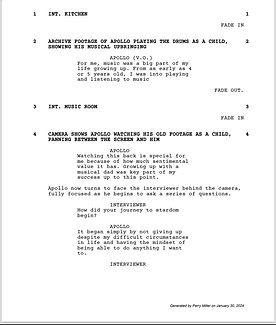

Script for factual film

Location recce

Shooting schedule

Equipment booking

Shot list

Risk assessment

Storyboard

Sound log
Poster production


Social media


Factual film


Products created for campaign

Billboard

Factual film


Double-page spread
Magazine front cover
Social media profile

Unit 16- Factual film
